
People & Organisation - The Foundation
Digital service transformation often fails for one reason: organisations buy or configure the platform before they agree the outcome, fix the workflow, or trust the data. This 5-part series shares a Solution Architecture approach that helps you design service excellence in the right order so the technology actually delivers measurable value.
Architecture is a useful lens because it forces discipline: you start with foundations, you agree the blueprint, and you only then select materials. In service management, IT sits at the centre of that structure, not as a ticket factory, but as the capability that connects people, process, data, and the platforms that run them.
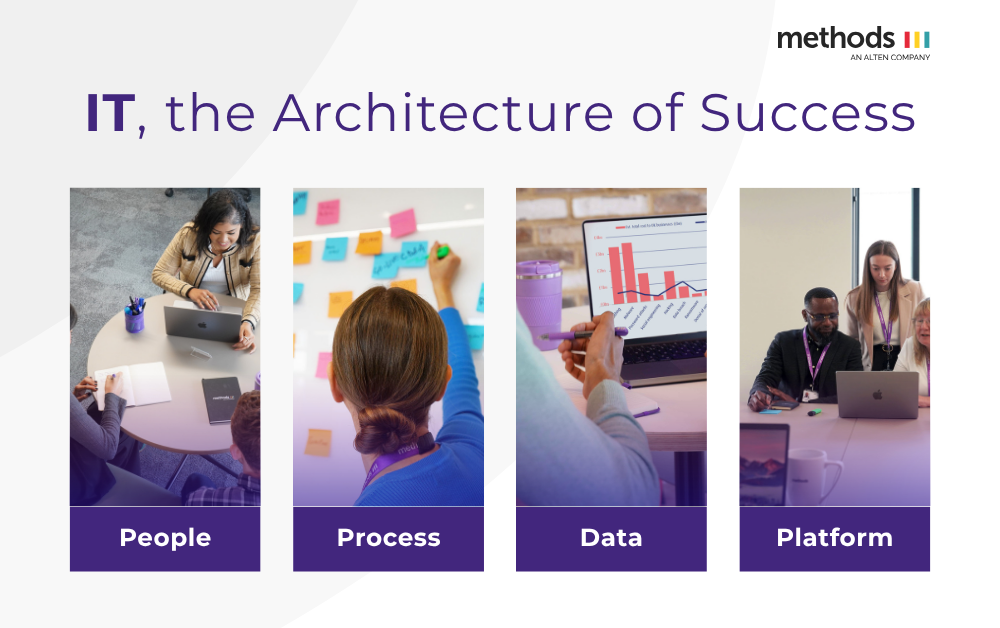
The most common mistake is starting with the technology. To build a resilient service architecture, work from the bottom up: align people, design the process, secure the data, then configure the platform. The hierarchy below summarises that order:.png?width=509&height=320&name=blog%201%20%20(2).png)
1. People & Organisation - The Foundation
You cannot automate a culture you haven't built. Before discussing technology, you must understand the People.
-
Who are the stakeholders?
-
What are their pain points?
-
Does the organisational structure support collaboration, or is it siloed?
Service excellence begins with human buy-in. If the people don't understand the "why," the "how" doesn't matter.
2. Process - The Blueprint
Once the people are aligned, you design the Process. A bad process automated is just a bad process that happens faster. Solution Architecture demands that we map out the journey—from a customer’s initial request to the final resolution—ensuring it is lean, logical, and repeatable.
3. Data - The Intelligence
With people aligned and processes mapped, we look at Data. Data is the fuel that runs the engine. In a service-led architecture, data must be clean, structured, and accessible. It’s the "truth" that tells you whether your processes are actually working and where your people need more support.
4. Platform - ServiceNow The Control Tower and Powerplant
Only after addressing the first three layers do we arrive at the Platform. This is where ServiceNow comes into play.
ServiceNow (or an equivalent enterprise workflow platform) shouldn’t be the first decision, it should be the enabler of decisions you’ve already made about outcomes, workflow, and data. When it sits on top of a clear People → Process → Data foundation, it can deliver:
- Visibility: See the end-to-end service journey across teams and systems in near real time.
- Experience: Provide a consistent, consumer-grade way for customers and teams to request and deliver services.
- Velocity: Automate the manual steps identified in your process mapping.
When IT is designed as part of the business architecture, teams stop being “order takers” and become “value creators”. The sequence matters: People → Organisation → Process → Data → Platform. Follow that order and the platform reinforces good behaviour instead of masking inefficiency.
Executive check: Ask your team to name one high-volume service and provide a one-page view of (1) the outcome owner, (2) the customer definition of “done”, and (3) the top 3 hand-offs causing delay. If they can’t produce this quickly, you don’t yet have a stable foundation for automation.
Next week (Part 2): People & Organisation. Keep an eye for next weeks’ blog where we look at the importance of stakeholder mapping, breaking silo friction and create the decision rights you need for adoption.